Civil Service Structure & Charter
UK-Governance proposes a Civil Service aligned to the principal functions of government. Professional expertise, clear responsibility and measurable results would connect each department’s work to the National Mission, Mission-Focused Budgeting and a rolling 15-year plan.
This proposal brings together eight functional departments, independent parliamentary scrutiny and a dedicated authority for transformation projects. It is offered for public examination and refinement.
Proposed structure
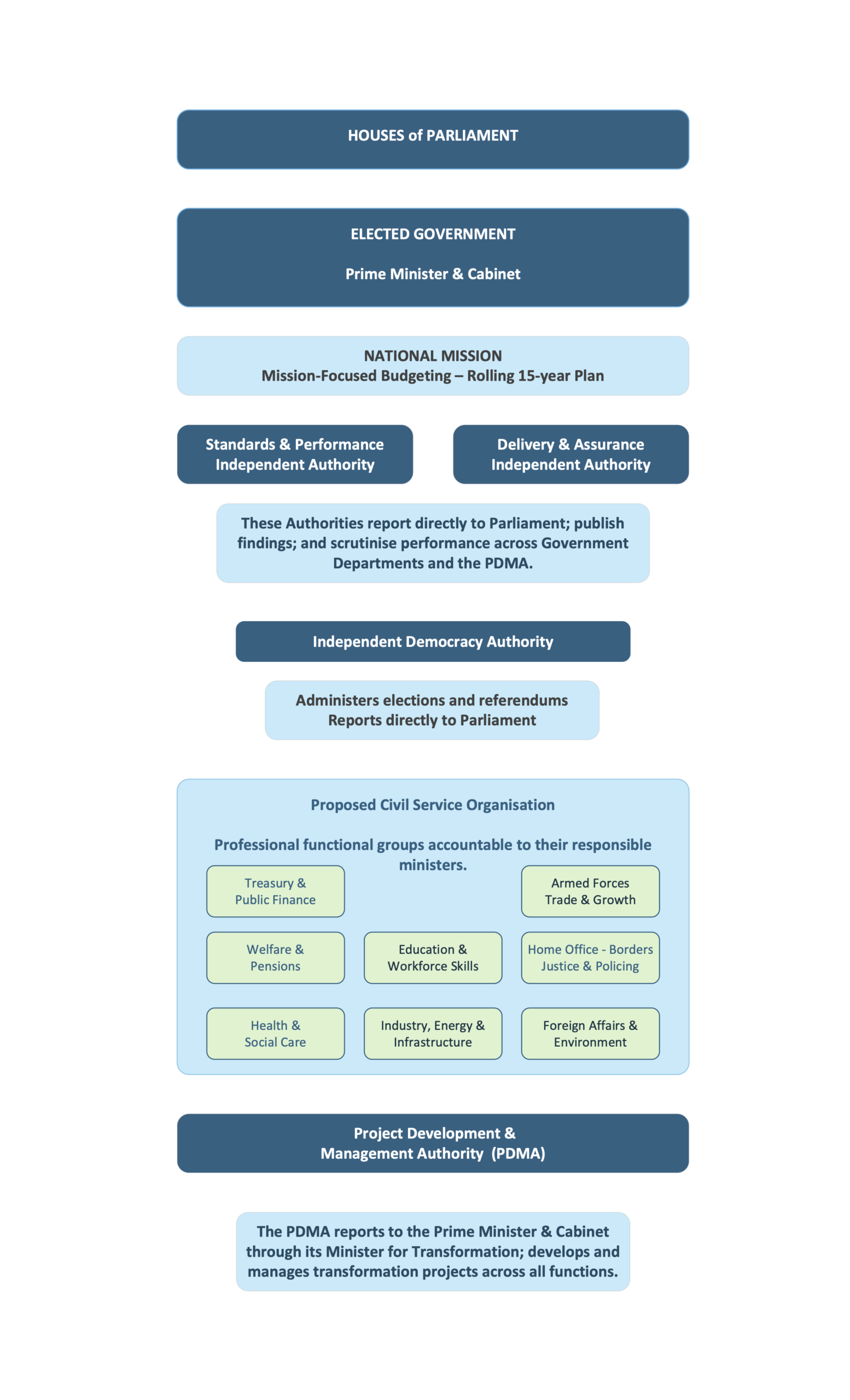
Eight functional departments
Each department would bring together the professional Civil Service capabilities required to support its responsible ministers. These are proposed departmental arrangements; detailed responsibilities and relationships with devolved and local government would be established during development.
1. Treasury & Public Finance
Provide financial stewardship, taxation advice and disciplined expenditure planning. Connect annual budgets to the rolling 15-year plan, compare spending alternatives using multiple criteria, publish assumptions and uncertainty ranges, and support independent examination of value for money.
2. Welfare & Pensions
Administer pensions and social support effectively, protect people in need and support routes into work where appropriate. Establish the composition, costs and outcomes of expenditure so that reform rests on evidence and the consequences for people are understood.
3. Health & Social Care
Support accessible, effective health and care services with sustainable funding. Develop recovery and productivity plans, assess public and private provision against outcomes, and maintain preparedness for health emergencies.
4. Education & Workforce Skills
Develop capability through schools, colleges, universities, apprenticeships and vocational training. Strengthen science, technology, engineering and mathematics alongside the wider education and skills needed by society, public services and industry.
5. Industry, Energy & Infrastructure
Rebuild productive capacity and secure reliable, affordable energy and effective infrastructure. Identify investment and skills requirements, compare alternative projects and coordinate delivery across transport, utilities and other essential networks.
6. Armed Forces, Trade & Growth
Support the expansion and effectiveness of Britain’s armed forces while developing opportunities for industrial production, technological innovation, skilled employment and exports. Coordinate defence procurement, industrial capacity and international partnerships; assess economic benefits alongside costs and security requirements.
7. Home Office — Borders, Justice & Policing
Support effective border management, immigration administration, policing and justice. Establish clear service responsibilities, lawful processes, measurable performance standards and accountability for delivery.
8. Foreign Affairs & Environment
Support diplomacy, international cooperation and environmental stewardship at home and abroad. Address pollution, ecosystems and the environmental effects of production and consumption, including imported goods. Work with Treasury, industry and defence to assess national interests and international obligations together.
Responsibilities & accountability
Prime Minister, Cabinet & responsible ministers
The government sets priorities and takes lawful decisions. Each functional Civil Service department is accountable to its responsible ministers for advice, administration and delivery. The National Mission, common budgeting framework and rolling plan coordinate work across functions.
Standards & Performance Independent Authority
Establish standards and performance measures within its statutory remit, examine results and publish findings. The proposed authority would report directly to Parliament and scrutinise performance across government departments and PDMA.
Delivery & Assurance Independent Authority
Examine the deliverability of plans and projects, including costs, progress, risks and results. It would report directly to Parliament and publish findings, including its independent assessment of PDMA’s work.
Both authorities would recruit their own specialist staff outside the Civil Service. Appointments would require demonstrated competence, integrity and independence. Their proposed statutory arrangements would provide access to evidence, transparent reporting and formal responses to significant findings.
Independent Democracy Authority
Administer elections and referendums independently and report directly to Parliament. Constitutional arrangements would determine who can initiate referendums and which decisions require public consent.
Project Development & Management Authority (PDMA)
Develop, assess and manage transformation projects across all functions. PDMA would have its own Minister for Transformation, accountable to the Prime Minister and Cabinet for its work across government. Each project would have a named sponsor responsible for its intended benefits.
Project preparation would examine alternatives, costs, risks and competing uses of funds before commitment. Delivery would use agreed scope, milestones and budgets, with controlled and documented decisions on changes. The independent Delivery & Assurance Authority would scrutinise its performance.
Civil Service Charter — proposed standard
This Charter defines professional duty, delivery and accountability within the proposed structure. Ministers decide; the Civil Service enables lawful, competent and economical delivery, supported by honest advice and independent scrutiny.
The Civil Service role
- Serve the lawful government of the day.
- Provide competent, evidence-based advice and convert decisions into delivery.
- Steward public resources responsibly.
- Preserve institutional memory.
- Maintain public trust through integrity and impartiality.
Core standards of behaviour
- Political impartiality: serve without partisan preference and provide the same professional quality of advice regardless of minister or party.
- Truthfulness and candour: provide the facts, state uncertainty, risks and trade-offs, and correct errors promptly.
- Respect for evidence: distinguish evidence, analysis and opinion; examine inconvenient findings and avoid selective presentation.
- Integrity of office: declare and manage conflicts, protect public money and refuse improper direction, favouritism or misuse of authority.
- Accountability for outcomes: treat implementation as integral to policy, own delivery quality within the department’s remit, escalate risks early and learn from failures.
Accountability within the proposed structure
Functional departments are accountable to responsible ministers and subject to independent scrutiny. They must maintain consistency with the National Mission, budget commitments and rolling plan, cooperate with PDMA and supply the evidence required by the independent authorities.
Traceability from purpose to results
Every major commitment should connect its purpose, objectives, budget, delivery plan, outcomes and review. Where that connection cannot be demonstrated, civil servants must flag the gap and propose corrective action.
Delivery discipline
- Specify milestones, owners and deliverables for major commitments.
- Maintain clear, current reporting of delivery risks.
- Require evidence of implementation and results.
- Record and assess proposed changes to project scope, cost or timetable.
Value for money
- Treat public expenditure as stewardship.
- Quantify costs, benefits, risks and opportunity costs where practicable.
- Challenge duplication and repeated pilots without demonstrated progress.
- Recommend stopping or redesigning activities that cannot demonstrate value.
Institutional memory & decision records
Maintain accessible records of the options considered, criteria applied, trade-offs accepted, assumptions, uncertainties and triggers for review or reversal. Preserve experience and lessons across changes of personnel and government.
Standards for advice to ministers
Advice must be clear about the decision required, complete in its consideration of credible alternatives, honest about risks, testable against evidence, implementable and auditable. Its purpose is to enable competent decisions and delivery.
Escalation, dissent & integrity
Civil servants must escalate concerns where legality is in doubt, material facts are ignored, delivery risks are concealed, value for money is failing or institutional standards are overridden without reason. Professional candour is a duty.
Competence & professional development
Appointment, training and promotion should reflect demonstrated competence in the relevant function, delivery performance, stewardship and contribution to institutional capability. Career development should strengthen expertise and preserve continuity.
A public-facing standard
The public should be able to judge whether the Civil Service enables lawful, competent and economical governance, with visible decisions, trade-offs and outcomes.
Professional candour, delivery discipline and stewardship of public money are the foundation of this proposed Charter.
Standards for Professional Duty, Delivery, and Accountability
Purpose
This Charter sets out a proposed standard of behaviour and professional duty for the Civil Service, aligned to a governance model in which:
- each major governance function has its own professional Civil Service group; and
- all functions are bound by a central spine that enforces purpose → strategy → budgets → delivery → outcomes → accountability.
It is offered as a proposal for scrutiny, refinement, and adoption.
Status
This Charter is proposed, not imposed.
It is intended to support a credible, non-partisan operating principle:
Ministers decide. The Civil Service enables lawful, competent, economical delivery and honest accountability.
The Civil Service Role
The Civil Service exists to:
- serve the lawful government of the day;
- provide competent, evidence-based advice;
- convert decisions into delivery;
- steward public resources responsibly;
- preserve institutional memory; and
- maintain public trust through integrity and impartiality.
Core Standards of Behaviour
Civil servants commit to the following minimum standards.
1. Political Impartiality
- Serve the lawful government of the day without partisan preference.
- Provide the same professional quality of advice regardless of minister or party.
2. Truthfulness and Candour
- Provide ministers with the facts, not what is convenient.
- State uncertainty, downside risk, and trade-offs explicitly.
- Correct errors promptly and transparently within the system.
3. Respect for Evidence
- Use evidence honestly, including inconvenient evidence.
- Distinguish clearly between evidence, analysis, and opinion.
- Avoid selective presentation designed to support a predetermined conclusion.
4. Integrity of Office
- Declare and manage conflicts of interest.
- Protect public money and public trust as primary duties.
- Refuse improper direction, favouritism, or misuse of authority.
5. Accountability for Outcomes
- Treat implementation as integral to policy, not an afterthought.
- Own delivery quality within remit and escalate risks early.
- Avoid shifting blame between departments, contractors, and ministers as a substitute for learning.
Behaviour Locked to the Proposed Structure
This Charter assumes an operating model with:
- Functional Civil Service Groups (domain competence), and
- a National Strategy & Priorities spine (coherence and discipline), plus
- a deployable Delivery Corps (programme/commercial/digital/ops capability).
Civil servants in this model commit to:
A. Two-Axis Accountability
Each functional group is accountable:
- to ministers for lawful direction and priorities; and
- to the central spine for:
- strategy coherence,
- budget alignment,
- value-for-money discipline,
- delivery assurance,
- and institutional memory.
This prevents silo drift and makes trade-offs visible.
B. Strategy-to-Budget Traceability
Civil servants will ensure major work is traceable through:
Purpose → Strategy → Budget Line → Delivery Plan → Outcomes → Review
Where traceability cannot be established, civil servants must flag it and propose corrective action.
C. Delivery Discipline as Professional Duty
Civil servants must:
- specify milestones, owners, and deliverables for major programmes;
- maintain red/amber/green visibility for delivery risks;
- prevent “announce and move on” government by requiring delivery evidence.
D. Value for Money as a Moral Obligation
Civil servants will:
- treat public expenditure as stewardship, not entitlement;
- quantify costs, benefits, risks, and opportunity costs where practicable;
- resist wasteful duplication and perpetual pilots;
- recommend stopping or redesigning programmes that cannot demonstrate value.
E. Institutional Memory and Decision Records
For major decisions and programmes, civil servants will keep accessible records of:
- options considered;
- criteria used;
- trade-offs accepted;
- assumptions and uncertainties;
- triggers for review or reversal.
A system without memory repeats expensive mistakes.
Standards for Advice to Ministers
Civil servants must ensure advice is:
- clear (what decision is required),
- complete (credible alternatives included),
- honest (risks and constraints explicit),
- testable (criteria and evidence visible),
- implementable (delivery pathway stated),
- auditable (reasons and trade-offs recorded).
The purpose of advice is not to produce paperwork.
It is to enable competent decisions and delivery.
Escalation, Dissent, and Integrity
Civil servants must escalate when:
- legality is in doubt;
- material facts are being ignored;
- delivery risk is being concealed;
- value for money is clearly failing;
- or institutional standards are being overridden without reason.
Escalation is not disloyalty.
It is professional duty.
Competence and Professional Development
Civil servants should be appointed, trained, and promoted on:
- demonstrable competence in the relevant governance function;
- delivery performance and stewardship;
- and contribution to institutional capability and memory.
Rotation must not substitute for expertise.
A Public-Facing Standard
This Charter exists to make one question unavoidable:
Is the permanent state enabling lawful, competent, economical governance — and making trade-offs and outcomes visible?
If not, reform is required regardless of intent.
Closing Principle
The Civil Service must never govern in place of elected authority.
But it must also never enable drift, waste, or evasion through silence.
Professional candour + delivery discipline + stewardship of public money are the minimum conditions of credible governance.